Redesigning the donation flow to increase conversion by 75%.
Increasing donor conversion by 75% and transforming campaign creation into a self-serve workflow
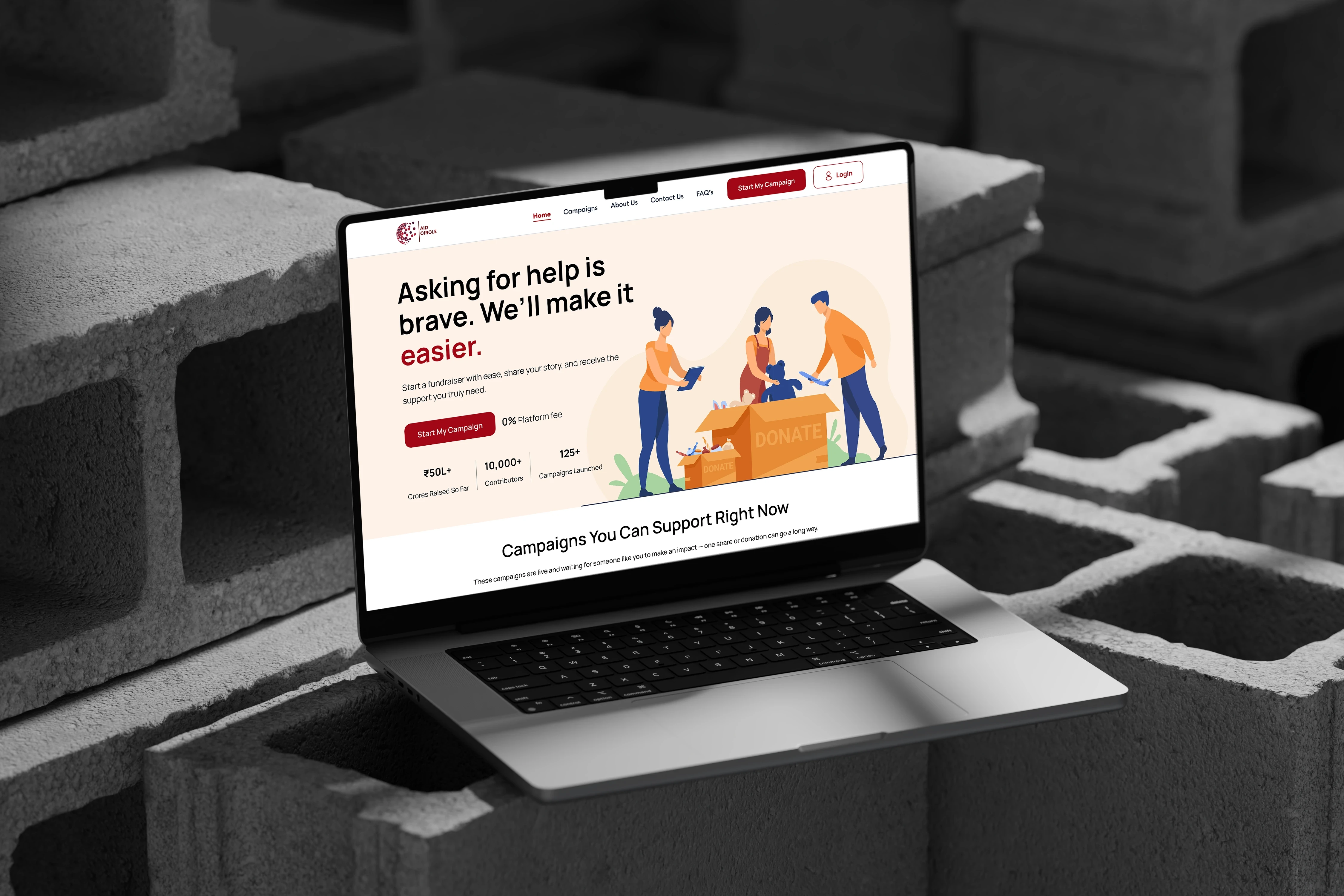
About AidCircle
AidCircle is an Indian crowdfunding platform that helps individuals raise funds for medical emergencies, education, and social causes.
Overview
The project focused on improving donation conversion and replacing AidCircle's manual campaign creation process with a self-serve fundraising platform.
At the time, AidCircle was driving traffic to campaign pages through paid social media campaigns, but only 1.2% of visitors were converting into donors. At the same time, creating a fundraising campaign required multiple back-and-forth interactions with the operations team, making campaign launches slow and difficult to scale.
I redesigned the platform end-to-end, improving the donor experience by making campaign impact and credibility immediately visible, while transforming campaign creation into a guided self-serve workflow.
Industry
Crowdfunding
My Role
Product Designer
Timeline
2 Months
Team
1 PD, 1 PM and 3 Engineers
75% Increase in donation conversion
The donation conversion was increased from
1.2% to 2.1%.
10 min campaign launch time
Campaign creation and launch time is reduced from 24–48 hours to 10 minutes
Problem
Crowdfunding in India runs on trust and urgency, people give to strangers in moments of crisis, often from their phones, in seconds. AidCircle had the traffic and the causes. What it didn't have was a donation experience that earned trust fast enough to convert that traffic, or a way to launch campaigns without the team in the loop every time.
Understanding why donors weren't converting
I audited the full donor journey then validated what I found against AidCircle's analytics and a teardown of four crowdfunding platforms (Ketto, Milaap, ImpactGuru and GoFundMe). The biggest drop-offs lived on two surfaces, so I've focused here on those: the campaign page and the donation flow.
Campaign page audit
The campaign page is where visitors decide whether a cause is worth supporting. I audited the experience to identify the friction and trust gaps that prevented users from converting into donors.

Donation flow audit
The donation flow is where donor intent turns into action. I audited the experience to identify the friction and trust gaps that prevented users from confidently completing their donation.

Let's look at the analytics
The analytics reinforced the audit findings. While campaigns attracted a steady stream of visitors, very few completed donations, suggesting that the challenge wasn't bringing users to the platform it was giving them enough confidence to contribute.
12.4K Monthly Visitors on campaign page
Majority arriving from paid social campaigns
84% Drop-off on campaign page
Low-intent bounce indicative of friction
91% Drop-off on donation modal
Donors abandoned at the final payment step
13s Avgerage engagement time
Insufficient trust-building window
1.2% Donor conversion rate
Only 1 in 83 visitors completed a donation
67% Form abandonment rate
Donors dropped off before completing payment
Competitor analysis
To understand how successful crowdfunding platforms encourage users to donate, I analyzed leading competitors across trust, transparency, information hierarchy, and donation experience. These insights established a benchmark for evaluating AidCircle and informed the redesign decisions that followed.
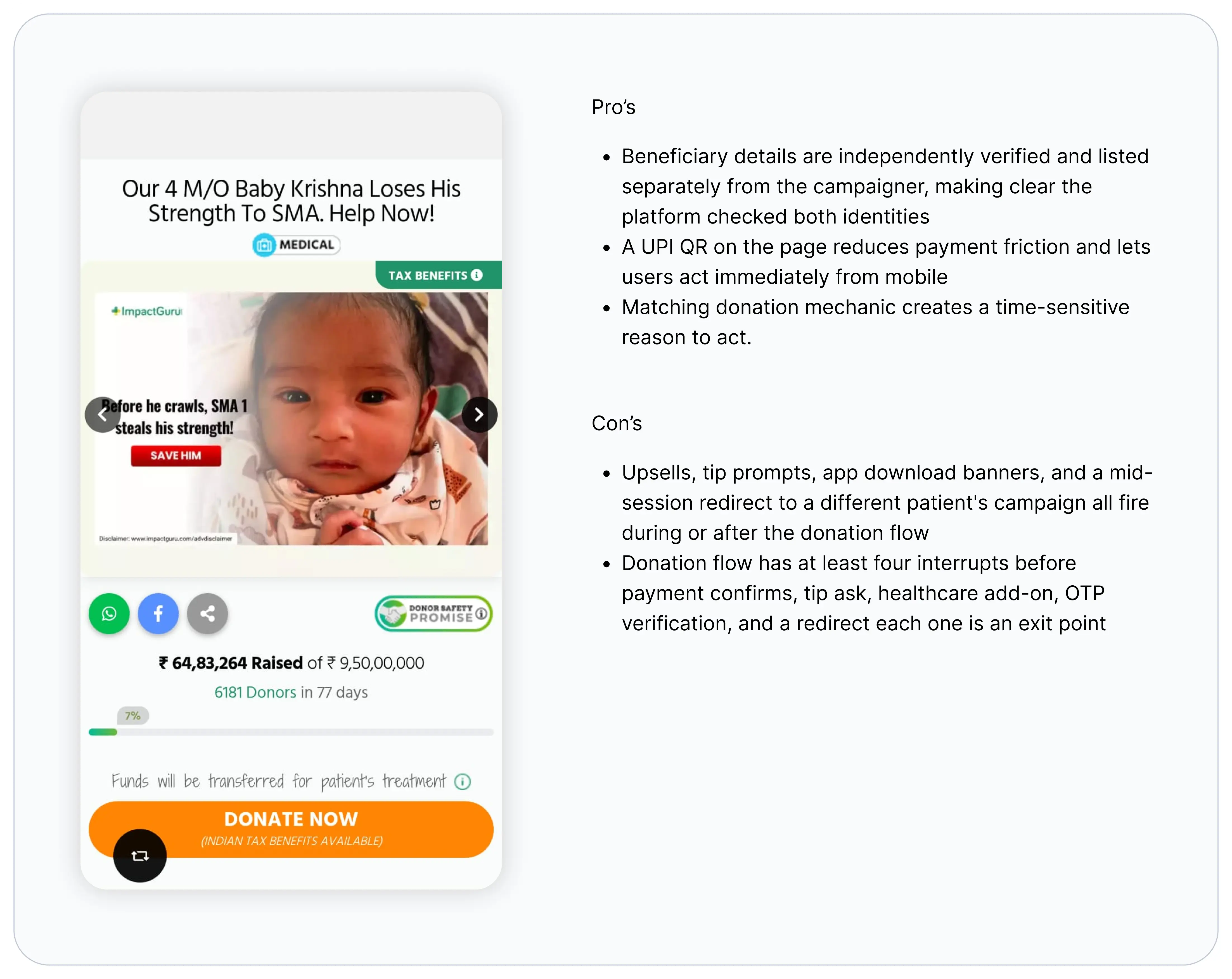
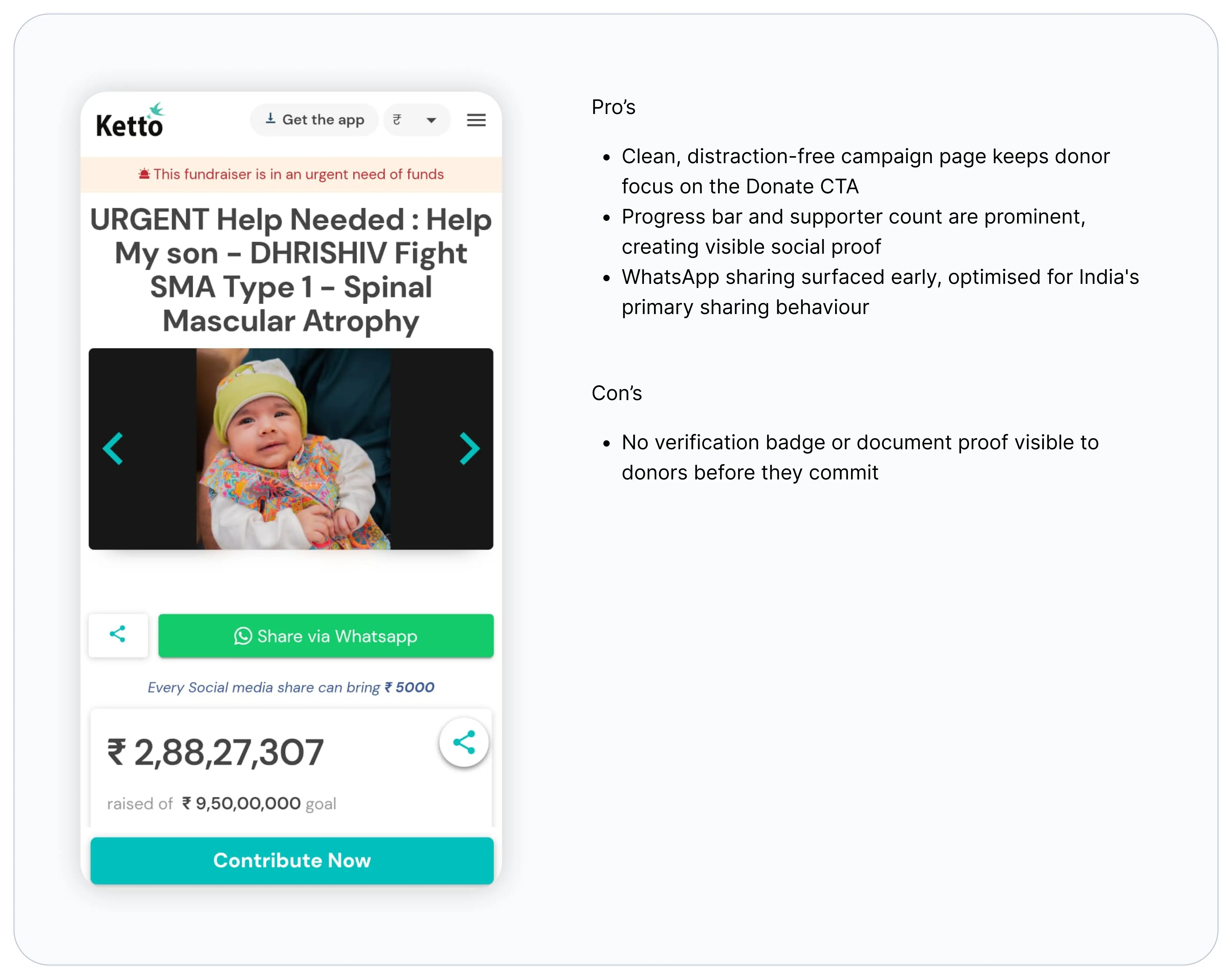

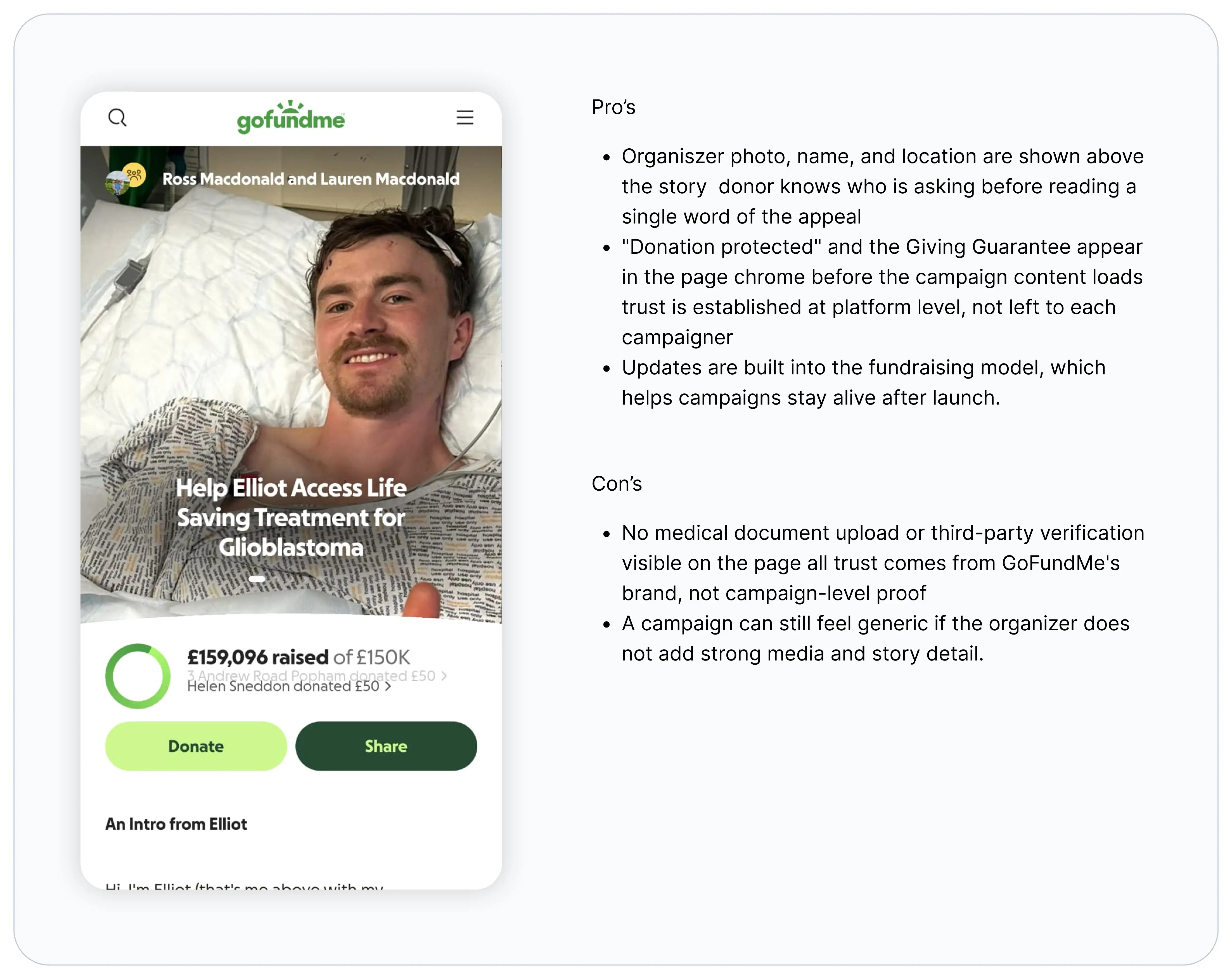
Across the platforms we analyzed, three patterns consistently emerged:
Trust is designed into the experience, not left for users to figure out on their own.
Transparency is prioritized through clear information hierarchy and easy access to supporting details.
Donation flows stay focused on one goal: helping users complete their contribution with minimal friction.
SUMMING IT UP:
The audit revealed missing trust signals and usability gaps across the campaign page and donation flow.
Analytics confirmed high visitor drop-offs, indicating the problem was converting users rather than attracting them.
Competitor analysis highlighted trust, transparency, and simplicity as consistent patterns behind successful donation experiences.
[Problem 01]
Low donor conversion
Visitors were reaching campaign pages but dropping off before completing donations due to a lack of trust, transparency, and a seamless donation experience.
[Problem 02]
Manual campaign creation
Fundraisers couldn't launch campaigns independently. Every campaign required manual review and publishing by the AidCircle team, extending the process to 24-48 hours.
Process
Translating research into design strategy
The research made it clear that solving AidCircle's challenges wasn't about adding more features it was about reducing uncertainty for donors while simplifying operations for fundraisers. Instead of addressing individual UI issues, I established three design principles that guided every design decision.
Build Trust
Help users verify campaign authenticity before asking for a donation.
Improve Transparency
Present critical campaign information in a structured and easily scannable way.
Reduce Friction
Simplify key journeys to help users complete tasks with minimal effort.
Architecting a self-serve campaign creation experience
The biggest challenge wasn't replacing a manual form with a digital one. It was redesigning an operational workflow into a scalable self-serve system while balancing three competing needs: helping genuine fundraisers launch quickly, maintaining donor trust through verification, and reducing operational dependency on the AidCircle team.
Design decisions
Before designing the self-serve campaign creation experience, I established three product decisions that balanced three competing needs
A frictionless onboarding experience for fundraisers.
Fraud prevention and verification for the platform.
Operational efficiency for the internal team.
These decisions shaped the workflow architecture and guided every design decision that followed.
Progressive Onboarding
Verify the fundraiser first through OTP, then gradually collect campaign information to reduce abandonment and ensure genuine users enter the flow.
Context-Aware Forms
Questions adapt dynamically based on the selected fundraising category, collecting only relevant information while reducing unnecessary inputs.
Trust Without Delays
Campaigns are published immediately after submission, while verification happens in parallel. The verified badge and fund withdrawals are enabled only after successful review.

Solution
[Solution 01]
Increasing Donor Confidence
The research revealed that users hesitated to donate because they lacked sufficient confidence in the campaign's legitimacy. Rather than treating the campaign page and donation flow as separate experiences, I redesigned them as a single conversion journey, building trust before the donation decision and reducing friction during checkout.
Campaign page
For campaign page I choose two column layout because a single-column layout would require users to scroll through the entire campaign before reaching the donation action, increasing interaction cost and creating opportunities for distraction or drop-off. Keeping the donation panel persistently visible ensures users can act immediately when they feel confident, without interrupting their decision-making journey.

Donation form
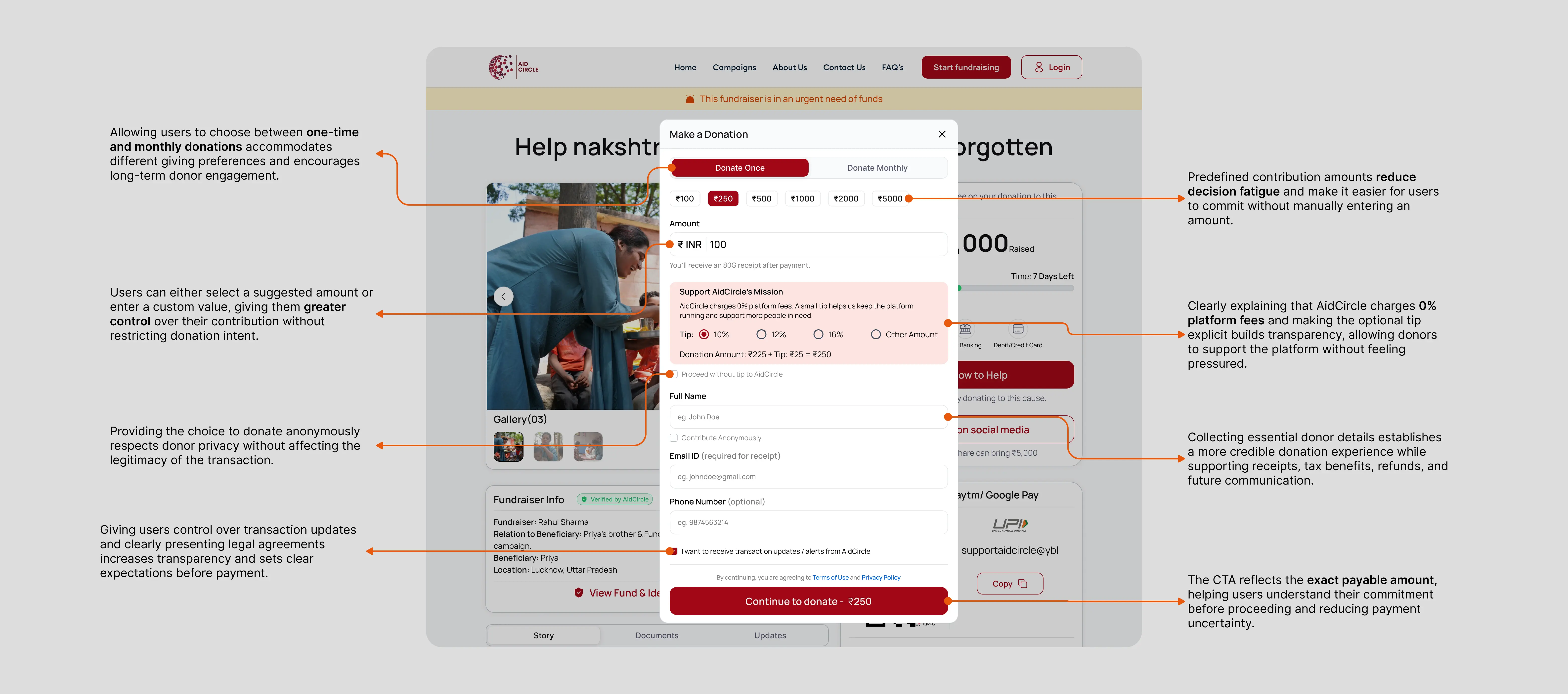
The redesigned donation flow transforms the modal from a simple payment prompt into a transparent donation checkout. By reducing decision friction, collecting essential donor information, and clearly communicating transaction details, the experience strengthens trust at the final step and helps convert donation intent into completed contributions.
[Solution 02]
Enabling Self-Serve Campaign Creation
The second challenge existed behind the scenes. Campaign creation relied heavily on manual coordination, slowing down onboarding and increasing operational effort. I redesigned the process into a guided self-service workflow, allowing fundraisers to create campaigns independently while ensuring all required information was collected consistently.
Campaign creation flow
The redesigned donation flow transforms the modal from a simple payment prompt into a transparent donation checkout. By reducing decision friction, collecting essential donor information, and clearly communicating transaction details, the experience strengthens trust at the final step and helps convert donation intent into completed contributions.


In summary, I transformed a manual trading process into a self-serve platform by
75% Increase in donation conversion
The donation conversion was increased from
1.2% to 2.1%.
10 min campaign launch time
Campaign creation and launch time is reduced from 24–48 hours to 10 minutes
"Santosh did a fantastic job revamping the AidCircle website. He understood our vision, brought in fresh ideas, and delivered a clean, user-friendly design. His attention to detail, quick turnarounds, and proactive suggestions made the process smooth and effective. Highly recommended for anyone looking for a creative and dependable designer.”